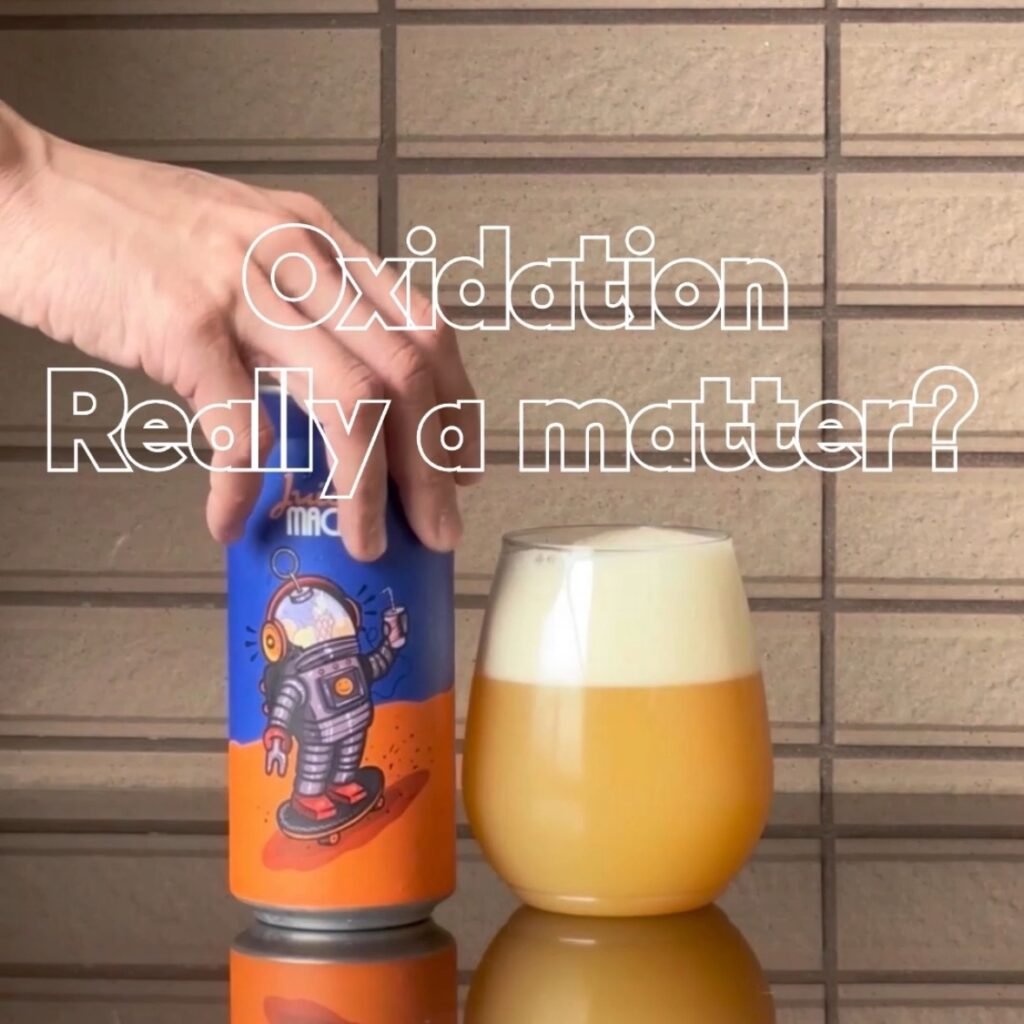
Oxidation is not an uncommon word for beer geeks, who may have heard terms like papery, cardboard, or stale associated with oxidation in beer. Some of them may have heard that if beer is stored warm, or if certain beer styles like IPAs are stored for several months, the beer can become oxidized and lose its character.
However, on the other end of the spectrum, we also hear from some beer geeks that beers are not at their best when they are freshly released from the brewery, and that they should sit for 2 to 3 weeks to reach their prime. Others may say, “We are drinking beer, not drinking the date.” What does oxidation in beer actually mean?
Let’s go back a little bit before we deep dive into oxidation in beer. In my personal experience, I had never heard of oxidation as a negative term when consuming food. I had heard about food getting spoiled or causing food poisoning when exposed to air for too long, or French fries losing their crispiness when sitting out, but oxidation was seldom mentioned.
The first time I heard about oxidation was during my science class in early high school, when we learned that iron oxidizes in the presence of oxygen and moisture. Still, it was never associated with off-flavors in food, and I never heard that oxidized food could not be consumed.
I was only notified about beer oxidation when I started to deep dive into beer knowledge, learning that oxidation in beer is an off, undesirable flavor that most brewers and beer judges want to avoid. However, if you ask average consumers or other beverage professionals, they may not detect this off-flavor, and they may not think oxidized beer is bad.
What does oxidation in beer really mean?
Oxidation in beer is not just exposure to air; it is an ongoing oxygen degradation process. Because beer contains a volatile mix of alcohol, proteins, hop compounds, and amino acids, it undergoes a chain reaction that causes it to decompose at a molecular level, unlike foods where oxidation primarily ruins fats. It is not something that will poison your beer. In some cases, it creates undesirable flavors and makes desirable flavors disappear, though it can also create certain profiles that consumers enjoy. Regardless, oxidized beer is entirely harmless to consume.
When fresh beer is packaged and exposed to dissolved oxygen, oxidation does not happen all at once. It follows a highly predictable, domino-effect timeline that food scientists and brewers divide into three main chemical stages: the radical phase, the muted phase, and the staling phase.
The timeline opens with the radical phase, spanning from day one to week two. This is the invisible ignition phase where you won’t taste cardboard yet, but the chemical trap is being set. First, trace metal ions like Fe² or Cu⁺ react with the dissolved oxygen in the fresh beer, triggering a Fenton reaction that converts stable oxygen into highly destructive reactive oxygen species like hydroxyl radicals (⋅OH). Because beer is mostly water and alcohol, these aggressive radicals immediately attack ethanol to create highly reactive 1-hydroxyethyl radicals. These radicals then attack the alpha-acids (isohumulones) from the hops, initiating their slow breakdown into bitter, sweaty, or cheesy butyric and isovaleric acids.
In the same period, hop burn, that aggressive, scratchy, throat-burning sensation common in fresh, hazy IPAs, usually settles out. This burn is caused by a triple threat of microscopic debris: hop polyphenols (tannins), high concentrations of unrefined volatile hop oils (like myrcene), and physical hop particulates suspended in the liquid.
When packaged beer is kept cold during the first one to two weeks, these heavy, abrasive particulates naturally flocculate and precipitate out of suspension to the bottom of the can, bottle, or keg, eliminating the source of mechanical friction.
Concurrently, the chemistry of the radical phase works in the background as highly destructive 1-hydroxyethyl free radicals selectively target and oxidize the raw, volatile hop hydrocarbons first. By breaking the double chemical bonds of these stinging compounds and mutating them into softer, muted structures, the chemical bite on the throat’s trigeminal nerves is significantly dulled. This creates a narrow peak flavor window around day 10 to 14, where the harsh burn has vanished but the desirable, delicate fruity profile has not yet been systematically dismantled by ongoing oxidation.
This transitions the beverage into phase two, the muted phase, which occurs between weeks 2 and 6. This is where the consumer first notices that the flavor in the beer is changing, as the beer does not taste bad yet, but simply starts tasting different and perhaps boring.
During this phase, a wide array of fresh hop aroma terpenes and yeast-derived esters are highly sensitive to degradation. When oxygen attacks these compounds, the beer undergoes a dual negative effect: it systematically loses its fresh, fruity characteristics while simultaneously forming heavy, artificial, or solvent-like off-flavors. This initiates a complete flavor inversion where light, volatile, vibrant notes are chemically destroyed and heavy, dense, chemical compounds are constructed in their place.
Looking closely at the destruction of fresh hop terpenes, these molecules normally provide bright floral, citrus, and herbal notes. The 1-hydroxyethyl radical aggressively steals hydrogen atoms from them, causing myrcene, the most abundant and highly volatile terpene in hops, to break down first and lose its punch. This causes the beer’s bright, dank hop pop to completely vanish within weeks, leaving behind a muddy, muted hop profile. Linalool, highly prized in IPAs for its pleasant, floral-citrus pop, degrades into linalool oxides, causing its aroma to shift from fresh flowers into a dull, heavy, woody, or stale green tea note. Geraniol, which yeast can typically convert into sweet citrus beta-citronellol, undergoes rapid autoxidation to turn into a harsh, perfumy, cheap soap-like off-flavor.
Simultaneously, the fresh, light esters created by yeast during fermentation to give a beer its fruity personality undergo chemical hydrolysis and split apart. Isoamyl acetate, the quintessential ester providing the fresh banana and pear drop profile in German wheat beers and many Belgian ales, breaks down rapidly, leaving the beer tasting flat, dull, and prematurely old. The lighter esters ethyl hexanoate and ethyl octanoate, which provide lagers and blonde ales their delicate, crisp fruitiness of fresh red apple, anise, and pineapple, also have their bonds broken, stripping the beer of its crisp, refreshing profile.
As these fresh top notes vanish, the first distinct off-notes appear. The degraded terpenes shift as limonene and geraniol hydrate into alpha-terpineol and carvone, creating a heavy, solvent-like citrus turpentine or medicinal aroma that completely ruins the fresh hop profile.
Concurrently, the radicals quickly break down polyunsaturated fatty acids in the presence of trace metals. When beer comes into contact with low-quality brewing equipment, poorly coated aluminum cans, or mineral-heavy brewing water containing trace iron or copper, these metal ions act as catalysts that drastically speed up the oxidation of the small amount of lipids present. This reaction produces 1-octen-3-one, a compound with an incredibly low flavor threshold that delivers a sharp metallic note, smelling and tasting like sucking on a copper penny or a rusty nail.
A variation of rancidity also develops, especially in darker or poorly stored beers, because barley malt contains natural lipids and fatty acids like linoleic acid. During mashing, or if oxygen enters during packaging, direct autoxidation or the enzyme lipoxygenase breaks these fatty acids down into short-chain fatty acids like butyric and isovaleric acids, presenting as a sweaty, cheesy, or old-butter rancidity.
The process finally advances into the staling phase, taking place from the months 2 to 6 and beyond.
The fresh characters are now long gone, and heavy, stale, oxidized compounds are actively constructed. This phase brings the cardboard wave, which is the most famous and universally recognized sign of old, stale beer. Precursors formed early on during the boiling of the wort stay bound up and hidden until they are finally cleaved open by continuous chemical adjustments. At the same time, fatty acids finish breaking down via autoxidation, peaking in the creation of (E)-2-nonenal. This is the exact molecule responsible for the wet cardboard, stale paper, or cereal box flavor discovered when a macro-lager is left in a warm garage for six months.
It is also important to note that a beer can be heavily oxidized even when the classic wet-cardboard note is completely absent. The development of (E)-2-nonenal depends heavily on beer style, storage temperature, and brewery processing.
In high-ABV beers like Imperial Stouts, Belgian Quads, or Barleywines, cardboard is missing because a high alcohol content acts as a solvent that masks lighter aldehydes, while heavily roasted malts contain powerful natural antioxidant melanoidins that physically block its formation, leaving severe alcohol and ester oxidation to dominate instead.
If a beer is contaminated with oxygen but kept consistently cold-stored and refrigerated at 2 to 4°C, the cardboard note will be delayed for months because the chemical breakdown of malt lipids requires thermal energy. Instead, polyphenol oxidation dominates, rapidly stripping the beer of its clean hop bitterness and forming a permanent, cloudy oxidation haze and an astringent mouthfeel.
In modern Hazy IPAs, massive dry-hopping introduces a vast amount of hop oils and hop material that acts as a sponge, absorbing oxygen before it can reach the malt lipids. Cardboard does not have time to form before a severe hop teardown occurs, causing the beer to lose 100% of its fresh tropical citrus juice aroma within weeks without any noticeable papery sensation.
Additionally, in low-pH or highly acidic sour beers like Berliner Weisses, Goses, or Lambics, the high acidity inhibits the aldol condensation pathway needed to create the classic cardboard aldehyde. Instead, the esters mutate into heavy lactones, degrading the fresh fruit and lactic tartness into a heavy, cloying, artificial peach, apricot, or honey-sweet flavor.
Beyond the development of (E)-2-nonenal in the staling phase, as the fresh esters die, the creation of heavy esters and ethers occurs as oxidized alcohols and organic acids are forced to recombine, changing the fruit profile from fresh-picked to overripe or chemical. Oxidative reactions synthesize cyclic lactones like γ-nonalactone and γ-hexalactone, creating a peach shift that introduces a heavy, sweet peach, apricot, or plum flavor that masks the intended malt and hop profile.
Triggered by the oxidation of higher alcohols, a dark fruit and wine shift occurs as ethyl phenylacetate and ethyl 3-methylbutyrate emerge over time to turn the aroma into sweet port wine, sherry, dried raisins, or prunes. In top-fermented ales, thermal stress and oxidation cause a massive spike in 2-furfuryl ethyl ether, which features a very low flavor threshold and gives aged beer a harsh, chemical, industrial solvent, or varnish-like off-flavor.
The timeline reaches a sherry and honey finish as the 1-hydroxyethyl radical finishes converting into stable acetaldehyde, turning the main alcohol in beer from a green apple or emulsion paint scent into heavy, sweet, vinous notes. If oxidation continues, higher fused alcohols oxidize into aldehydes and esters like benzaldehyde, which smells like almonds or marzipan. This allows the beer to take on a sweet, heavy, sherry-like, port wine, or dark fruit aroma.
Simultaneously, malt oxidation occurs as Maillard compounds in the malt degrade during storage, causing malt sugars and amino acids to oxidize alongside fatty acids into specific aldehydes like 2-furfural and methional. This develops a distinct honey, sweet corn, graham cracker, or cooked caramel note, turning a clean malt sweetness into a heavy, cloying, artificial sweetness that masks refreshing crispness. Additionally, hop acid oxidation can occur depending on storage temperature; when alpha-acids are exposed to low levels of oxygen, they break down into humulinones, a transformation that diminishes the beer’s clean bitterness.
While this bittering degradation occurs, the ongoing breakdown of the surrounding ester and hop terpene architecture simultaneously serves to unmask volatile sulfur compounds that were previously hidden; as those fresh top notes recede, highly potent hop-derived thiols, such as 4-mercapto-4-methylpentan-2-one (4MMP), become fully exposed to the consumer’s palate. At low concentrations, this can taste fruity like blackcurrant or gooseberry, but as oxidation progresses, it transforms into a highly unpleasant ribes aroma, which is the polite brewing term for cat urine or sweat.
The final stage of this sequence is a total physical collapse through polyphenol oxidation, changing the physical appearance and mouthfeel of the beer. Oxygen causes polyphenols and tannins from the hops and malt to polymerize into larger chains while binding with proteins. This reaction turns the beer a darker, duller brown color, causes the beer to form a permanent cloudy oxidation haze, and strips away the clean bitterness of the hops, leaving behind a harsh, astringent, and tongue-drying sensation.
While these oxidative compounds are completely safe to consume and present no toxic health risks to a drinker, the brewing industry treats oxidation as the ultimate enemy because it threatens flavor balance, style authenticity, predictability, and commercial shelf life.
Brewing is a precise art and science where a brewer spends months selecting specific hops for their bright tropical aromas and malts for their clean, crisp sweetness. When uncontrolled oxidation happens, it doesn’t just add an unwanted cardboard note; it actively erases the hop and malt character you paid for. If a consumer buys a Juicy NEIPA and gets a sweet, heavy, turpentine-and-cardboard beverage instead, the beer has failed to deliver on its promise.
Beyond the glass, the commercial reality of shelf life makes oxygen a critical business hazard, as oxidation acts as the primary limiting factor of a brewery’s distribution radius. If a brewery cannot control dissolved oxygen during packaging, their beer might taste amazing fresh at the brewery but turn into wet cardboard after just two weeks on a warm grocery store shelf. For modern commercial craft brewing, keeping oxygen out is the only viable way to ensure that a beer shipped three states away tastes exactly how the brewmaster intended.