A few months ago, I wrote an article about the variety of pale lagers available in supermarkets and convenience stores in Asia, exploring their history, differences, and flavor profiles. This time, let’s focus on another beer category that is widely available in Asian markets: dark beers.
Dark beers refer to a group of beer styles characterized by their deep, rich colors. Generally, a beer is considered “dark” when it reaches roughly 15 to 20 on the SRM scale (or 30 to 40 on the EBC scale). This transition point includes styles like brown ales, porters, and dark lagers, where deep copper, brown, and black tones dominate over pale gold or standard amber.
To deeply understand dark beer, one must recognize that for the vast majority of human history, virtually all beer was inherently dark, and that dark beer itself is a broad visual and sensory spectrum rather than a deep amber or jet-black liquid.
Dating back thousands of years, from ancient Sumeria and Egypt through to medieval European monasteries, germinated grain was traditionally dried over open wood fires. This crude, direct-fire process inevitably scorched the malt, infusing worts with dark pigmentation and smoky accents, meaning pale golden beers are a relatively modern innovation made possible by clean, indirect hot-air kilning.
In modern brewing, while early eighteenth-century London birthed the robust, heavily hopped brown porter, it was Daniel Wheeler’s 1817 patent of the cylindrical drum roaster that revolutionized dark beer. His invention allowed maltsters to roast grain at extreme temperatures without direct wood smoke, giving birth to black patent malt and granting brewers precise control across the entire dark spectrum.
The visual depth of dark beer across this 15 to 40+ SRM spectrum is governed by how maltsters manipulate heat, moisture, and time to trigger specific thermal transformations within the grain. While pale base malts furnish the bulk of fermentable sugars and active enzymes, brewers blend in targeted proportions, ranging from 5 to 30 percent of the total grain bill, of specialized kilned, stewed, or roasted grains, as well as caramelized adjuncts like the dark candi syrups used in Belgian Dubbels.
In paler dark beers, maltsters create caramel or crystal malts by stewing moist green malt at lower temperatures to convert starches into liquid sugars inside the husk, followed by kilning at moderate temperatures between 120°C and 180°C. In darker porters and stouts, specialty malts like chocolate malt, black patent malt, and roasted unmalted barley are subjected to intense dry-heat roasting exceeding 200°C.
In both regimes, elevated heat drives non-enzymatic browning via sugar caramelization and Maillard reactions between amino acids and reducing sugars. These chemical pathways synthesize water-soluble nitrogenous polymer pigments called melanoidins. At moderate kilning temperatures, medium-molecular-weight melanoidins yield luminous garnet, ruby, and copper shades, whereas high-temperature roasting forms dense, high-molecular-weight melanoidins that absorb virtually all visible light, resulting in completely light-proof, jet-black brews.
Beyond appearance, the specific thermal threshold used during malting generates a distinct, highly complex array of volatile aromatic chemicals, with paler dark beers relying on a completely different flavor chemistry than their pitch-black counterparts.
In beers like brown ales, Munich Dunkels, and Belgian Dubbels, where lower roasting temperatures preserve higher ratios of maltol to pyrazines, thermal reactions produce abundant furans, furanones, and pyrones. Key among these are furaneol and sotolon, which contribute lush, sweet aromas of butterscotch, burnt sugar, and rich caramel.
Working alongside them, furfural and 5-hydroxymethylfurfural (5-HMF) introduce warm notes of toffee, honey, and molasses, while pyrones like maltol and isomaltol bestow a sugary warmth and baked bread-crust richness. To create the characteristic nuttiness of brown ales and Dunkels, nitrogen-containing heterocyclic compounds such as pyrroles and lower-temperature alkylpyrazines interact to yield unmistakable notes of toasted hazelnut, walnut, roasted peanut, and fresh biscuit. In Belgian Dubbels, these caramel-rich furanones and toasted pyrroles intertwine with Strecker aldehydes like isovaleraldehyde and yeast-derived fruit esters, generating luxurious layers of dark plum, dried fig, and raisin.
As malting temperatures surpass 200°C to produce the intense black malts used in heavy porters and stouts, this sweet, nutty chemical profile undergoes pyrolysis, shifting the sensory signature toward a bolder, more aggressive end of the spectrum. At these extreme roasting heats, delicate furans and pyrones volatilize and break down, allowing higher concentrations of heterocyclic alkylpyrazines, such as 2,3,5-trimethylpyrazine and acetylpyrazines, to take command. These heavy pyrazine molecules are responsible for the sharp, comforting aromatics of freshly brewed dark-roasted coffee beans, bitter espresso, dark cocoa powder, toasted grains, and charred bread crust.
Concurrently, minor phenolic compounds, guaiacol derivatives, and organic acids released from the heavily scorched grain husks impart a subtle astringency and tannic dryness. This clean, roasted bitterness balances the lingering unfermentable sugars and heavy mouthfeel, creating a sophisticated bittersweet finish.
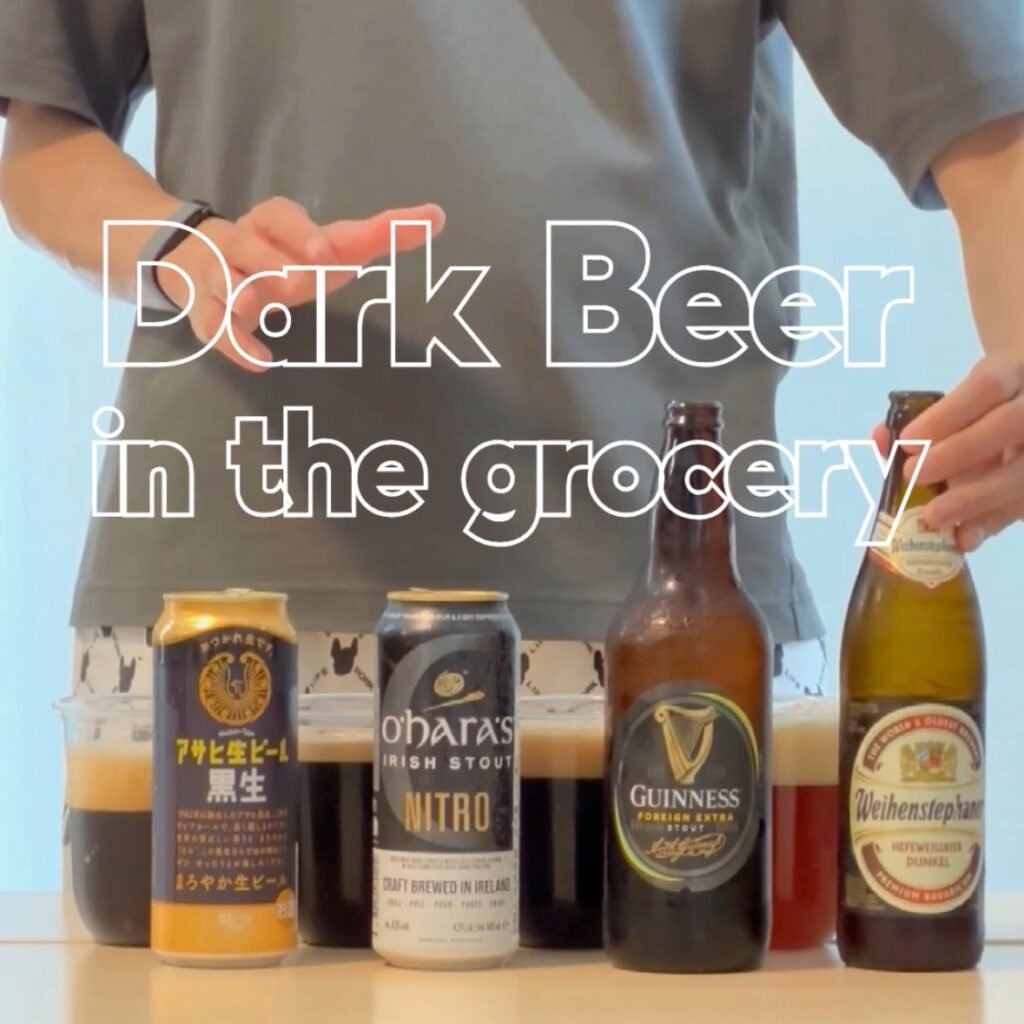
In Asia, particularly in Hong Kong and China, several dark beer styles are commonly found in convenience stores and supermarkets. However, whether a brew is a lighter shade of dark or completely opaque, these beers are often collectively referred to as “Black Beer,” even when they aren’t truly black in color. Because of this catch-all name, consumers often assume they are all identical. In reality, they belong to distinct beer styles, each with its own unique character, aroma, and flavor profile.
As bottom-fermenting lager technology spread from Germany and Austria to the Americas, Asia, and the Caribbean, industrial brewers sought to create dark brews tailored to broader, warmer markets. Drawing inspiration from classic Munich Dunkels and Bohemian dark lagers, these international variations modified traditional recipes by incorporating modern, highly efficient base malts alongside lighter adjuncts like corn or rice. The result was a stylized dark beer that delivered the visual charm and rich color of roasted malt without the heavy, filling weight of traditional European dark ales or dense German lagers, creating iconic staples across Mexico, Japan, and beyond.
What distinguishes the International Dark Lager from stouts, porters, or heavy dark ales is its extraordinarily clean, smooth flavor profile designed for maximum drinkability.
Rather than relying on heavily charred grains that introduce a bitter, coffee-like character, brewers utilize subtle proportions of caramel, dark crystal, or de-bittered roasted malts to achieve deep copper, dark chestnut, or chocolate-brown hues. Balanced by very low hop bitterness and a lighter body, the International Dark Lager finishes remarkably crisp, dry, and refreshing, offering the aromatic warmth of a dark malt profile with the effortless drinkability of a classic lager.
In Hong Kong, commercial examples like Asahi Super Dry Black, and Tsingtao Dark Beer are easily found in this category.
Over the 19th and 20th centuries, Irish brewers carved out a distinct identity by incorporating dark-roasted unmalted barley alongside malted grains, giving birth to the classic Irish Dry Stout, a dark brew engineered to be lighter in alcohol yet rich in roasty depth. Simultaneously, to supply distant markets across the Caribbean, Africa, and Asia, brewers developed Foreign Extra Stout. Designed to survive long, humid sea voyages without spoiling in the era before modern refrigeration, this export variant was brewed with significantly higher original gravities, elevated alcohol levels, and aggressive hopping, establishing a global dark beer legacy that remains massive to this day.
While both styles share an opaque jet-black appearance, their unique flavor profiles and underlying chemistry diverge significantly due to differences in alcohol strength, yeast behavior, and grain bills.
The classic Dry Irish Stout relies heavily on roasted unmalted barley, imparting sharp aromatics of freshly pulled espresso, unsweetened cocoa powder, and dry charred grain. Because it maintains a lower alcohol content (typically 4% to 4.5% ABV) and very low residual sugar, this roast intensity combines with subtle hop alpha acids and grain tannins to yield a crisp, dry, and remarkably drinkable finish.
Guinness Draught is undoubtedly the most classic and commonly found example of this style, typically sold in a nitrogen-charged can to replicate the creamy mouthfeel of Guinness poured straight from a nitrogen draft tap. Beyond Guinness, Murphy’s Irish Stout is another widely available option.
In contrast, Foreign Extra Stout is a full-bodied powerhouse ranging from 6.5% to over 8% ABV. Its high-gravity fermentation weaves complex notes of dark dried fruits, such as figs, raisins, and prunes, into a dense foundation of dark chocolate, licorice, and burnt molasses. This pronounced malt sweetness is balanced by a firmer hop bitterness and a comforting alcohol warmth, creating a bold, complex, and intensely satisfying flavor profile. Guinness Foreign Extra Stout is the classic example, typically sold in standard bottles or cans, unlike the nitrogenated canned version of Guinness Draught.
Beyond these deeper dark beer styles, Dunkel Weissbier is another dark beer commonly found in Hong Kong supermarkets. However, it is often also labeled simply as “Black Beer,” even though it is actually much lighter than the other dark beers on store shelves.
Originating in Bavaria, Germany, this dark wheat ale is historically the ancestral forerunner of modern golden wheat beer.
What sets Dunkel Weissbier apart from dark lagers, porters, and stouts is its vibrant, three-way harmony between wheat protein, dark specialty malts, and iconic Bavarian yeast. Brewers combine a high proportion of malted wheat with Munich or caramel malts to yield gentle flavors of baked dark bread crust, toasted grain, soft caramel, and subtle milk chocolate. Crucially, the top-fermenting wheat yeast generates high concentrations of signature esters and phenols, which contribute aromas of ripe banana and warm, aromatic clove. Because this style is unfiltered and rich in wheat protein, it pours with a lush, creamy head and offers a silky, effervescent mouthfeel. Erdinger Weissbier Dunkel is a commonly found example that delivers this signature creamy, complex wheat profile.